If you have ever spent four hours carefully following a petal chart, only to hold up a floppy, shapeless piece of fabric that wilts over its stem wire, the culprit is almost never your hands. It is your fiber.
When crocheting wearable blankets or cozy oversized sweaters, crafters prioritize softness, stretch, and forgiving drape. But three-dimensional botanical sculpture and heirloom amigurumi operate under a completely different set of physical laws: stitch architecture, tensile resistance, and geometric memory.
In this guide, we break down why mercerized cotton remains the sovereign gold standard in high-end ateliers like Scheepjes and CrochetNa, why acrylic sabotages delicate petal curves, and how to dial in your hook gauge so every loop stands crisp and proud.
1. The Science of Crispness: What Mercerization Actually Does
Pick up a skein of standard raw craft cotton, and you will feel a soft, slightly absorbent, chalky fiber. Mercerized cotton, by contrast, feels cool to the touch, possesses a silky luster, and holds an unmistakable structural stiffness. That difference is not synthetic coating — it is structural chemistry.
Developed in 1844 by English chemist John Mercer, the mercerization process immerses spun cotton yarn into a controlled sodium hydroxide bath while holding the threads under high mechanical tension. This accomplishes three crucial mechanical transformations:
- Fiber Un-Twisting: Raw cotton fibers naturally resemble flattened, twisted ribbons under a microscope. Mercerization swells the cotton cell wall, transforming the flat ribbon into a smooth, circular cylinder.
- Specular Light Reflection: Because the outer fiber cuticle becomes perfectly cylindrical and aligned, light bounces off cleanly rather than scattering. This produces that subtle, porcelain-like sheen characteristic of heirloom botanical petals.
- Tensile Locking: Swelling increases the fiber’s intermolecular hydrogen bonds, raising tensile strength by up to 25%. When you pull a single crochet stitch tight, mercerized cotton locks in place and refuses to stretch or sag against gravity.
When you are shaping three-dimensional tulip petals, rose sepals, or miniature animal snouts, this rigidity means every increase (inc) and decrease (dec) holds its dimensional angle indefinitely.
2. Why Acrylic Sabotages Delicate Botanical Amigurumi
Acrylic yarn has undeniable virtues: it is affordable, widely accessible at big-box craft stores, and machine-washable. For baby blankets or oversized winter beanies, it is often a sensible choice. However, when applied to fine amigurumi and botanical sculpture, acrylic creates three major points of failure:
The “Halo Effect” Blurs Stitch Definition
Acrylic is manufactured from extruded petroleum filaments cut into staple lengths and crimped to mimic sheep wool. These synthetic fibers continuously shed microscopic fibers outward, creating a fuzzy surface halo. When crafting small-scale items (especially with tight single crochet stitches), this fuzzy halo fills in the valleys between your stitch ridges. Instead of razor-sharp, sculptural stitch definition, your piece looks blurry and indistinct.
Elastic Creep Under Wire Tension
Unlike plant cellulose (cotton or linen), acrylic is thermoplastic. It possesses synthetic elasticity that stretches under slight strain. When you insert floral wire into an acrylic stem or sew a wired petal into place, the acrylic fabric slowly yields, elongating over days or weeks until your flower droops downward.
Pilling and Static Dust Attraction
Heirloom pieces are meant to be displayed openly on desks, credenzas, and bookshelves. Acrylic builds up electrostatic charge that actively attracts household dust. Within six months, friction and dust produce unsightly pills that cannot be removed without damaging the underlying stitches.
3. Hook Gauge Pairing: The “Down-Sizing” Rule
If you look at the paper ball band of a quality 4-ply (fingering weight) or Sport-weight mercerized cotton yarn (such as Scheepjes Catona or DMC Natura), you will almost always see a recommended crochet hook size of 3.00mm to 3.50mm.
“When crafting heirloom botanical masterclasses or structured amigurumi, always ignore the ball band recommendation. Step down by at least 0.75mm to 1.00mm.”
Here is why: ball band recommendations are calculated for open wearable garments where fluidity and gentle drape are desired. For heirloom sculpture, you need the opposite: a dense, zero-porosity fabric weave.
By pairing a Sport-weight mercerized cotton with a 2.25mm or 2.50mm ergonomic hook, your single crochet stitches pack tightly together, creating an impenetrable canvas where:
- White polyfill stuffing can never peek through the stitches, even when the piece is firmly stuffed.
- Embedded brass floral stems and support wires remain completely invisible from the outside.
- Individual petal edges can be pinched, curved, and shaped by hand — and they will hold that curve permanently.
The Parisian Mint Tulip Bouquet
Experience the sculptural magic of mercerized cotton firsthand. Master our signature continuous-row petal shaping, invisible wire stems, and zero-wilt botanical assembly.
Explore The Parisian Mint Tulip Masterclass ($7.99 USD) ➔
Includes instant 300 DPI iPad Retina edition, 1-page Eco Chart, and step-by-step macro video tutorials.
4. Summary: The Heirloom Fiber Checklist
Before you begin your next botanical project or collector amigurumi, run through this quick fiber check to guarantee museum-grade results:
| Fiber Characteristic | Mercerized Combed Cotton | Standard Acrylic |
|---|---|---|
| Stitch Definition | Razor-sharp & crisp | Fuzzy with surface halo |
| Structural Memory | Holds sculpted curves permanently | Stretches and droops over time |
| Light Reflection | Porcelain, satin luster | Synthetic sheen or chalky matte |
| Display Longevity | Heirloom grade (decades of stability) | Pills and gathers static dust |
Your hands invest hours of love into every row you stitch. Pairing those hours with the right structural fiber ensures your finished make will be cherished on display for decades to come.
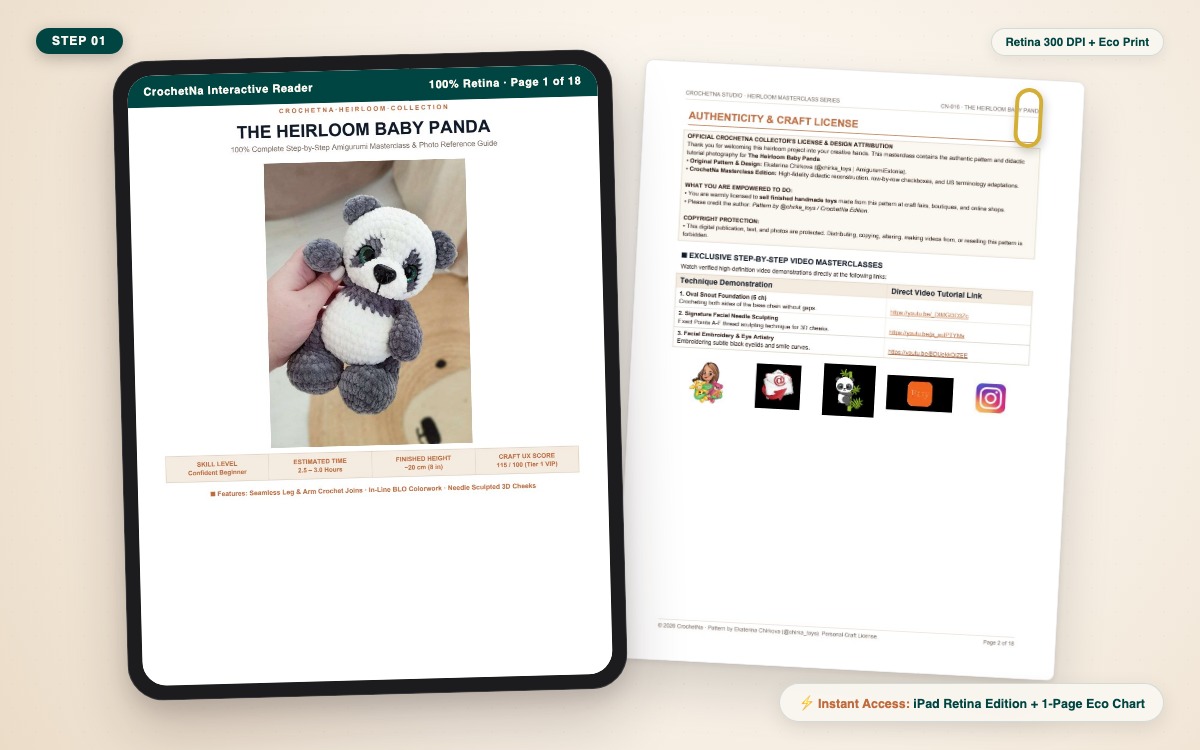
Download The Complete The Heirloom Baby Panda: Free Amigurumi Guide & Video Masterclass Masterclass
Instant digital access to both the Full-Color Deluxe iPad Edition and the Printer-Friendly Pure B&W Eco Ink-Saver.
- 100% Contiguous Row-by-Row: Every single stitch detailed with exact counts.
-
Interactive Checkboxes
[ ]: Track your completed rows effortlessly. - 68+ High-Resolution Step Photos: Crisp close-ups for every single join.
- Dual PDF Bundle: Deluxe 300 DPI Color + Eco Ink-Saver included.